Virtual Receptionist: Costs and Options in 2026
What is a virtual receptionist?
A virtual receptionist answers calls, books appointments, and handles routine front-desk tasks without a person sitting at a physical desk. That's the whole category on paper — but "virtual receptionist" now covers three genuinely different products, and confusing them is the most common reason businesses end up disappointed with whichever one they picked.
The three types are: a remote human answering service, an AI voice agent, and an on-site AI kiosk. All three get marketed as "virtual receptionist software," all three answer to roughly the same search terms, and none of them solve the same problem. This guide breaks down what each one actually does, what it costs in 2026, and — the part most buyer's guides skip — when phone-only coverage isn't enough and you need something physically present in your lobby instead.
The three types of virtual receptionist
1. Human answering service (remote, live agents)
This is the original virtual receptionist model: a shared pool of live agents, working off-site for an answering service company, picks up your business line under a script you provide. They can take messages, do basic scheduling, and transfer urgent calls. Because a real person is on the other end, they handle nuance and unusual requests better than any bot — but you're paying for human labor, so cost scales directly with call volume, and quality varies by which agent picks up.
2. AI voice agent (software-only)
An AI voice agent answers your business line using conversational AI instead of a human. It can triage calls, book appointments into a connected calendar, answer FAQs, and route anything it can't resolve. No physical presence, no hardware — it's a phone-only solution, and it's usually the cheapest tier because there's no human labor or hardware behind it. This is the category most people mean when they search "virtual receptionist software" today.
3. On-site AI kiosk (phone + physical front desk)
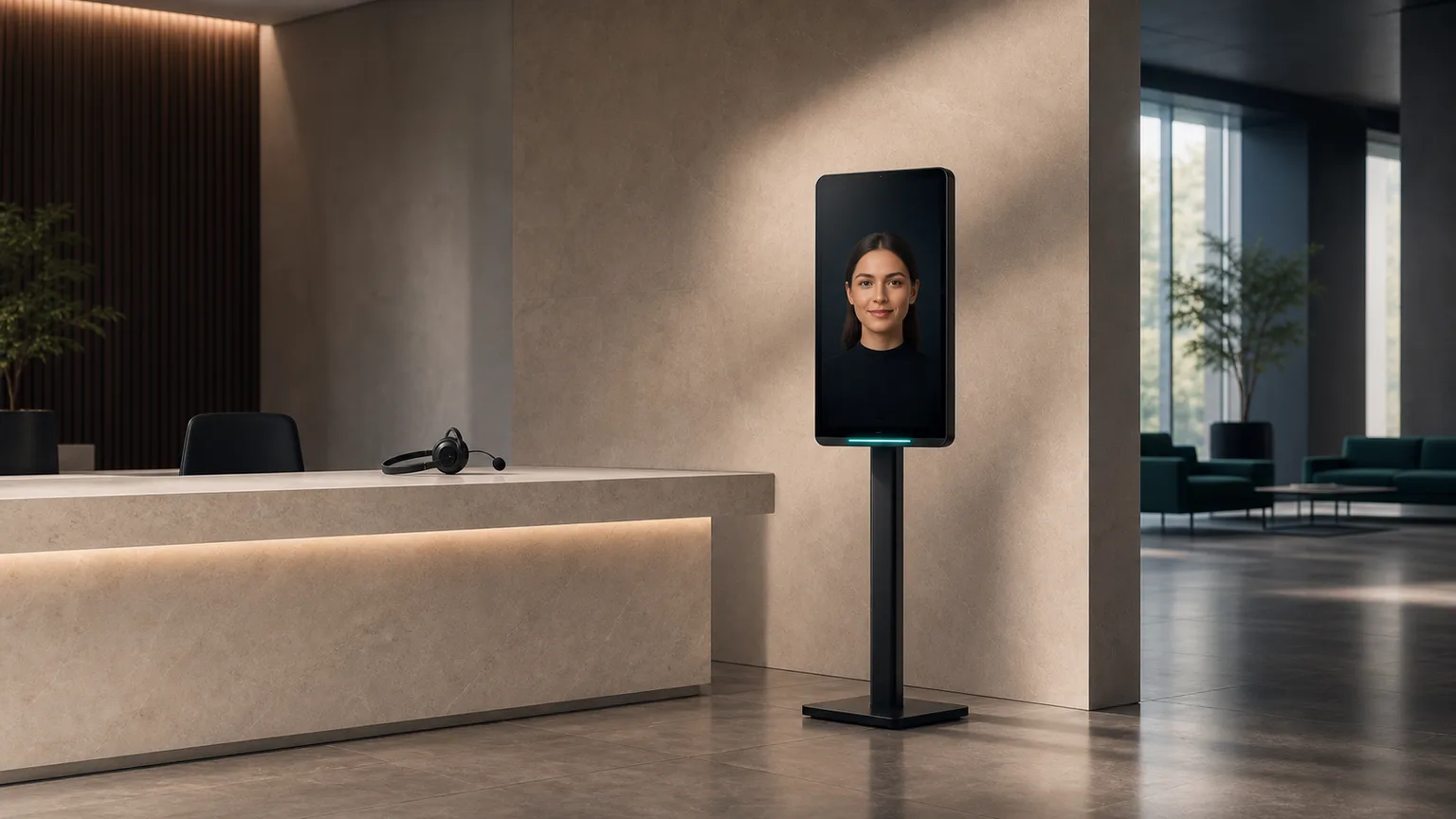
An AI avatar kiosk — like Face2me — does what an AI voice agent does over the phone, plus everything a phone-only tool structurally can't: it greets people who actually walk in, checks them in, verifies ID or insurance, and writes results back into your practice management or booking system in real time. It's not a replacement for a virtual receptionist so much as a different category that happens to also cover the phone. For background on how the kiosk side works, see our check-in kiosk complete guide.
Virtual receptionist pricing by type (2026)
| Type | Typical monthly cost | Billing model | Physical presence |
|---|---|---|---|
| Human answering service | $300-$1,000+ | Per-minute or per-call above an included allotment | None |
| AI voice agent | $50-$300 | Flat base fee, sometimes usage tiers | None |
| On-site AI kiosk (turnkey) | $599-$1,500+ per location | Flat, tiered | In-person + phone |
The spread within each row is wide because "virtual receptionist pricing" depends heavily on call volume, integrations, and how many lines or locations you're covering. A single-provider dental office and a five-location group are not going to land on the same plan even within the same product category. We cover the drivers behind kiosk pricing specifically in how much an AI receptionist costs.
Pros and cons by type
| Human answering service | AI voice agent | On-site AI kiosk | |
|---|---|---|---|
| Best at | Nuanced or unusual calls | Cheap, always-on phone coverage | Lobby traffic + phone, together |
| Weak point | Cost scales with volume; quality varies by agent | Can't do anything in person | Higher monthly cost, needs floor space |
| Setup speed | Fast — scripts, no hardware | Fast — mostly config, no hardware | Slower — hardware, integration, 7-10 business days typical |
| Handles walk-ins | No | No | Yes |
| Multilingual | Depends on agent pool | Varies by vendor | 30+ languages, auto-detected, on Face2me |
| Writes to PMS/CRM | Rarely, or manually | Sometimes, via integration | Real-time, built in |
How to choose by business type
- Solo practice or small office with light call volume. An AI voice agent is usually enough. You're solving "missed calls," not lobby traffic, and $50-$150/month covers it.
- Multi-line business fielding complex or sensitive calls. A human answering service earns its higher price when calls genuinely need judgment — insurance disputes, distressed callers, anything that punishes a wrong automated answer.
- Any business where people physically show up — clinics, hotels, gyms, salons, auto shops, coworking spaces. A phone-only virtual receptionist, human or AI, can't check someone in, scan an ID, or answer a question at the front desk. That's a structural gap, not a quality one. See how this plays out by vertical: dental, hotel, urgent care, fitness, salon, auto repair, and coworking.
- Businesses juggling both a busy phone line and a busy lobby. This is the case a kiosk is actually built for — one system covering both, rather than stitching together a phone vendor and separate front-desk staffing.
When a kiosk beats a phone-only virtual receptionist
The tell is simple: if your front-desk problem only happens on the phone, a phone-only virtual receptionist solves it. If people also walk through your door — to check in, ask a question, or wait for someone — a phone-only solution leaves that half of the job uncovered, and you're still paying for a human at the desk to handle it, which defeats the cost savings you were chasing in the first place.
An on-site kiosk like Face2me handles both under one system: it answers the phone, and it greets, checks in, verifies, and answers questions for whoever's standing in front of it — with the same conversational AI, the same integrations, and one monthly bill instead of two vendor relationships. For a clinic, that means insurance verification and intake happen before the patient sits down. For a hotel, it means ID and reservation lookup at 11pm without a night-shift hire. For a gym, it means membership and waiver checks at the door during the 6am rush.
It costs more than a phone-only AI voice agent — Face2me starts at $599/month versus $50-$300 for phone-only tools — but it's replacing more than a phone line. Compared against the fully loaded cost of a human front-desk hire ($3,000-$4,500+/month with benefits, payroll taxes, and turnover), a kiosk is still the cheaper option once you need coverage in the room, not just on the line.
If you're not sure which category actually fits your business, the fastest way to find out is to book a live demo and walk through your call and foot-traffic pattern with us directly.
FAQ
What's the difference between a virtual receptionist and an AI receptionist?
"Virtual receptionist" traditionally meant a remote human answering service; "AI receptionist" is a newer term for software or a kiosk that automates the same job. In practice the terms overlap heavily now — most vendors marketing "virtual receptionist software" in 2026 are actually selling an AI voice agent, not a human answering service, so check which one you're evaluating before comparing prices.
How much does a virtual receptionist cost per month?
It depends entirely on type. A phone-only AI voice agent runs $50-$300/month. A human answering service typically runs $300-$1,000+/month, billed per-minute above an included allotment. A turnkey on-site AI kiosk that also covers in-person check-in starts around $599/month. None of these are directly comparable line-for-line, since they cover different scopes of work.
Can a virtual receptionist book appointments?
Yes — both AI voice agents and human answering services can typically book into a connected calendar or scheduling system, though the depth of integration varies by vendor. An on-site AI kiosk goes further, writing appointment and check-in data directly into your practice management or property system in real time rather than just adding a calendar entry.
Is a virtual receptionist HIPAA compliant?
Not by default — it depends on the vendor and plan. If a virtual receptionist will handle protected health information (scheduling for a medical practice, taking messages that reference a patient's condition), confirm the vendor offers a signed Business Associate Agreement (BAA) before use. Face2me includes HIPAA compliance with a signed BAA on every tier; see our full HIPAA compliance breakdown for what that should cover.
Do I need a virtual receptionist if I already have a kiosk?
No — a good on-site AI kiosk like Face2me already answers phone calls in addition to handling walk-in check-in, so running a separate virtual receptionist service on top of it is usually redundant. The exception is a business with call volume across many lines that genuinely needs a dedicated phone-answering setup beyond what a single kiosk location handles.