AI Answering Service: Costs & Alternatives
What is an AI answering service?
An AI answering service is software that answers inbound business calls automatically — greeting the caller, understanding what they want in natural language, and either resolving the request (booking, rescheduling, answering an FAQ) or routing it to a human. Unlike a traditional answering service, there's no live agent on the other end unless the call escalates. Unlike an IVR ("press 1 for billing"), the caller talks in normal sentences instead of navigating a menu tree.
It solves one specific problem: missed calls. For a solo practitioner or small office, a ringing phone that goes to voicemail during a procedure, a haircut, or a busy lunch rush is a lost booking, not just an inconvenience. An AI answering service picks up every time, at any hour, without adding headcount.
What it does not solve is anything that happens in person. It can't greet someone standing in your lobby, scan an ID, verify insurance, or collect a copay before a visit. That distinction matters more than most vendors admit, and it's the reason "AI answering service" and "AI receptionist" get used almost interchangeably even though they cover different ground — see our broader best AI receptionist comparison for how the categories split.
How it differs from a human answering service
A human answering service routes your calls to an off-site call center, where a live agent — usually shared across many clients — picks up using a script built from your intake instructions. It's accurate and personable, but it's also expensive at scale, because every minute on the phone is paid labor. Pricing is almost always per-minute or per-call, which means a busy month costs meaningfully more than a slow one, and quality varies with whichever agent happens to answer.
An AI answering service replaces that live agent with a language model trained on your business's information — hours, services, providers, policies, and calendar availability. It answers instantly, never sounds rushed, and the marginal cost of an extra call is near zero, which is why AI answering services are usually priced as a flat monthly base rather than heavily metered. The tradeoff is that an AI system, however good, still struggles with unusual requests a live human would handle by judgment alone — an angry caller, a complex insurance question, an edge case the script never anticipated. Most AI answering services address this with escalation: routing anything outside their confidence to voicemail, a text follow-up, or a human on call.
How it differs from an IVR
An IVR (interactive voice response) is the "press 1 for appointments, press 2 for billing" system most callers already dread. It's rules-based, not conversational — the caller must guess which button matches their need, and anything that doesn't fit a menu item dead-ends. An AI answering service replaces the menu with open conversation: a caller says "I need to reschedule my Thursday appointment" and the system understands and acts on it directly, without forcing them through a decision tree first. The difference shows up immediately in call abandonment — callers hang up on IVRs far more often than on a system that just listens.
Typical pricing
AI answering services are usually the cheapest category of AI front-desk tool, because there's no hardware and no live agent. Expect:
- $50-$150/month for basic plans covering a modest call volume, often with per-minute overage past an included allotment
- $150-$300/month for plans with deeper integrations — calendar write-back, CRM sync, multi-location routing
- Per-minute or per-call billing above the included tier is common, which is the main way costs creep past the advertised "starting at" price
Compare that to a human-hybrid virtual receptionist service, which runs $300-$1,000+/month because a live agent is paid for time on the back end, or a turnkey AI kiosk, which runs $599-$1,500+/month flat because it includes hardware, integrations, and support rather than metering minutes. Our full AI receptionist cost breakdown covers all three tiers with ROI math.
Strengths and limits
Where an AI answering service wins:
- Eliminates missed calls, including after-hours and during busy periods
- Flat or near-flat pricing that's easy to budget against
- Fast setup — usually live within days, no hardware or on-site installation
- Handles simple booking, rescheduling, and FAQ requests without a human
Where it falls short:
- Phone-only — it has no way to interact with someone already in your lobby
- Can't perform ID or insurance verification, which requires a document scan
- Struggles with complex, judgment-heavy calls that a live agent would handle intuitively
- Doesn't solve check-in speed, no-show reduction at the point of visit, or in-person multilingual support
That last point is where a lot of clinics and practices get the category wrong: they solve the missed-call problem with phone AI, then discover their real bottleneck was always the lobby, not the phone line.
When a business also needs an in-lobby AI receptionist kiosk
If your front desk's real pain point is people already standing in front of you — patients waiting to check in, guests arriving without a reservation confirmed, walk-ins who need to be verified before they're seen — a phone-only AI answering service can't touch that. That's a distinct job: greeting a visitor face-to-face, verifying their identity or insurance, checking them in, and writing the result straight into your practice management or booking system in real time.
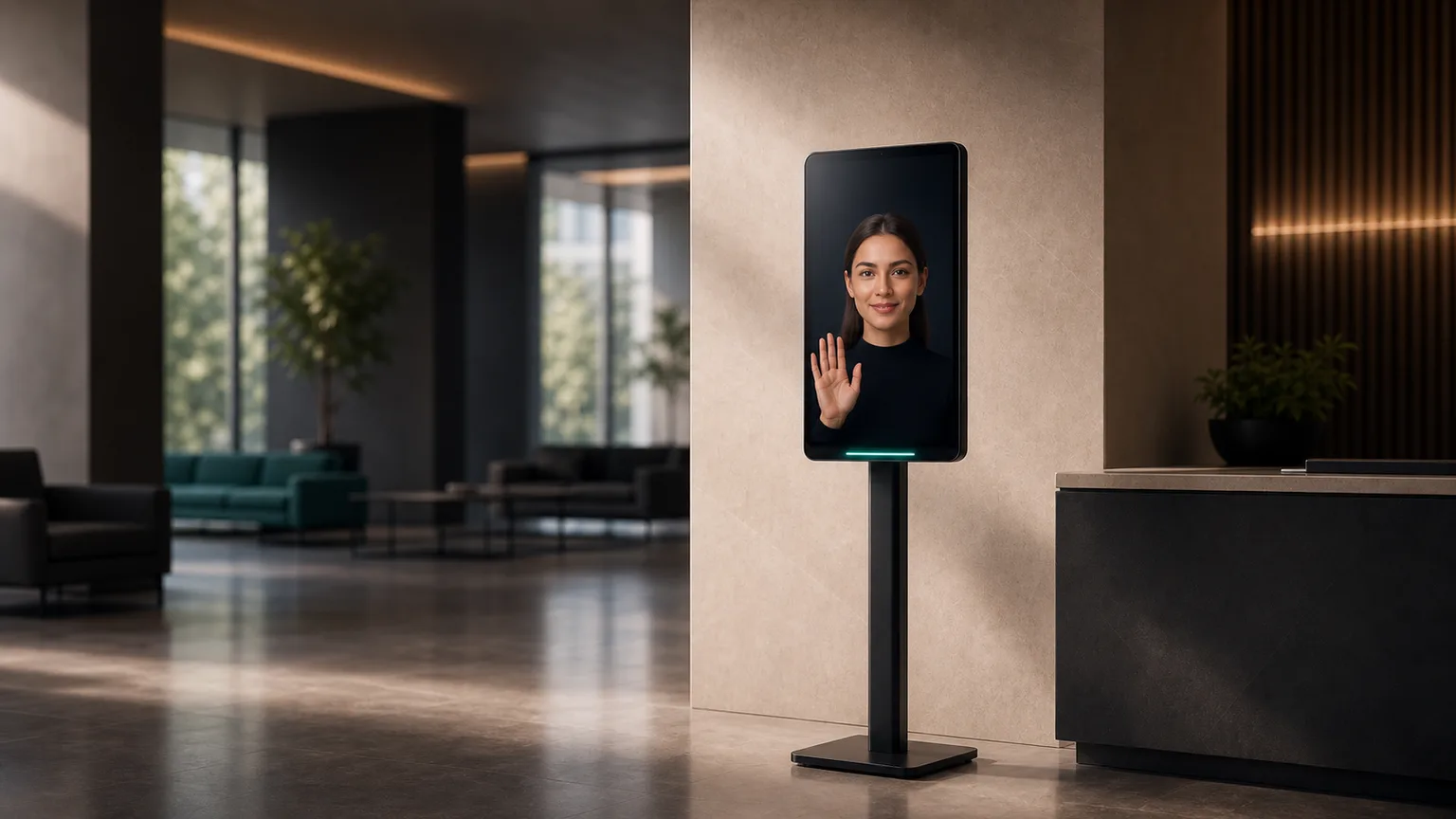
Face2me is built for that in-person moment. It's a touchscreen kiosk with a lifelike talking avatar that greets visitors, checks them in under 60 seconds on average, verifies insurance or ID, answers open-ended questions in 30+ auto-detected languages, and syncs with Dentrix, Open Dental, Opera PMS, Mews, and Mindbody. Its name-match accuracy for check-in runs 99.2%, and clinics using SMS reminders alongside kiosk check-in see roughly 40% fewer no-shows. It doesn't replace your phone line — most Face2me clients still run a phone AI or human line alongside it — it covers the part of the front desk a phone system structurally cannot reach.
This split shows up clearly across specialties. A dental practice needs both a phone system for scheduling calls and a kiosk for insurance verification and copay collection at check-in. A hotel needs a phone line for reservation calls and a kiosk for guest self-check-in. A medical spa or salon may lean more heavily on phone AI if most bookings happen by call, but still benefits from a kiosk if walk-in traffic and paperwork slow the front desk. Browse the full list of verticals to see how the split plays out for your specific business.
Decision table: which one do you actually need?
| Business situation | Best fit |
|---|---|
| Solo practice, missed calls are the main problem, no lobby traffic | AI answering service only |
| High call volume, complex or sensitive calls need human judgment | Human or hybrid answering service |
| Heavy walk-in or scheduled in-person traffic, check-in is the bottleneck | AI receptionist kiosk |
| Multilingual visitors arriving in person, not just calling | AI receptionist kiosk |
| Both missed calls and slow in-person check-in are hurting the front desk | AI answering service + kiosk together |
| Need ID or insurance verification before a visit | AI receptionist kiosk (phone AI can't do this) |
Most practices with real foot traffic — clinics, dental offices, hotels, gyms — end up running both: an AI answering service for the phone line, and a kiosk for the lobby. They solve different failure modes, and neither substitutes for the other.
If check-in speed, insurance verification, or multilingual walk-ins are where your front desk actually struggles, it's worth seeing the in-person side of this working directly — you can book a live demo and check in a mock visitor yourself.
FAQ
Is an AI answering service the same as an AI receptionist?
Not exactly. "AI receptionist" is used broadly across phone, chat, and kiosk categories, while an AI answering service specifically means phone-only call handling. A phone AI answering service can't check someone in or verify an ID in person — for that, you need a kiosk. See our best AI receptionist comparison for the full category breakdown.
How much does an AI answering service cost?
Basic plans typically run $50-$150/month, with deeper-integration plans reaching $150-$300/month. Many vendors bill per-minute or per-call past an included allotment, so a busy month can cost more than a quiet one. That's cheaper than a human-hybrid answering service ($300-$1,000+/month) and much cheaper than a turnkey AI kiosk ($599-$1,500+/month), but it also does far less — see our full cost breakdown.
Can an AI answering service replace a human receptionist entirely?
For phone-only businesses with simple call patterns, often yes. For any business with walk-in or in-person traffic — a clinic, dental office, hotel, or salon — an AI answering service only replaces the phone half of the job. The in-person half (greeting, check-in, verification) needs a kiosk or a human at the desk; phone AI structurally can't do it.
Do AI answering services work with practice management or booking software?
The better ones integrate with calendar and CRM systems for scheduling, but deep, real-time write-back into practice management systems like Dentrix or Open Dental — the kind needed for insurance verification and chart updates — is more common in kiosk platforms built specifically for healthcare and hospitality workflows, since that integration work is expensive to build and maintain.
What happens when an AI answering service can't handle a call?
Reputable services escalate: routing the caller to voicemail, a text-back follow-up, or a human on call rather than leaving them stuck in a loop. If a vendor can't clearly explain what happens on a call it can't resolve, that's worth asking about before you sign up — a dead end on a missed-call problem defeats the purpose of the service.