Best AI Receptionist in 2026: Full Comparison
What's the best AI receptionist?
There isn't one "best" AI receptionist — there are three different categories solving three different problems, and most of the disappointment with AI front desk tools comes from picking the wrong category, not the wrong vendor. A phone AI answering service can't check a patient in. A website chat agent can't verify insurance in a waiting room. A kiosk can't pick up a call while you're closed.
The right question isn't "which AI receptionist is best" — it's "which category matches what my front desk actually does all day," and then which vendor inside that category fits your integrations, languages, and compliance needs. This guide walks through all three.
The three categories of AI receptionist
1. Phone AI answering services
Software that answers inbound calls, takes messages, books simple appointments, and routes anything complex — either to voicemail, a human on call, or a text follow-up. No physical presence, no lobby, no check-in. This is the category most people mean when they search "AI front desk," because missed calls are the most common front-desk pain point for small offices and solo practitioners.
Best for: single-location businesses whose main problem is missed or after-hours calls, not lobby traffic or in-person check-in.
2. Website chat agents
Conversational widgets embedded on a website that answer FAQs, qualify leads, and book appointments through chat rather than voice. They live entirely online — a visitor never has to pick up a phone or walk into a location to interact with one. Setup is usually the fastest of the three categories since there's no phone number porting or hardware involved.
Best for: businesses whose first touch with a customer happens on the website — service businesses, e-commerce-adjacent practices, anyone booking appointments primarily online.
3. On-site AI kiosk receptionists
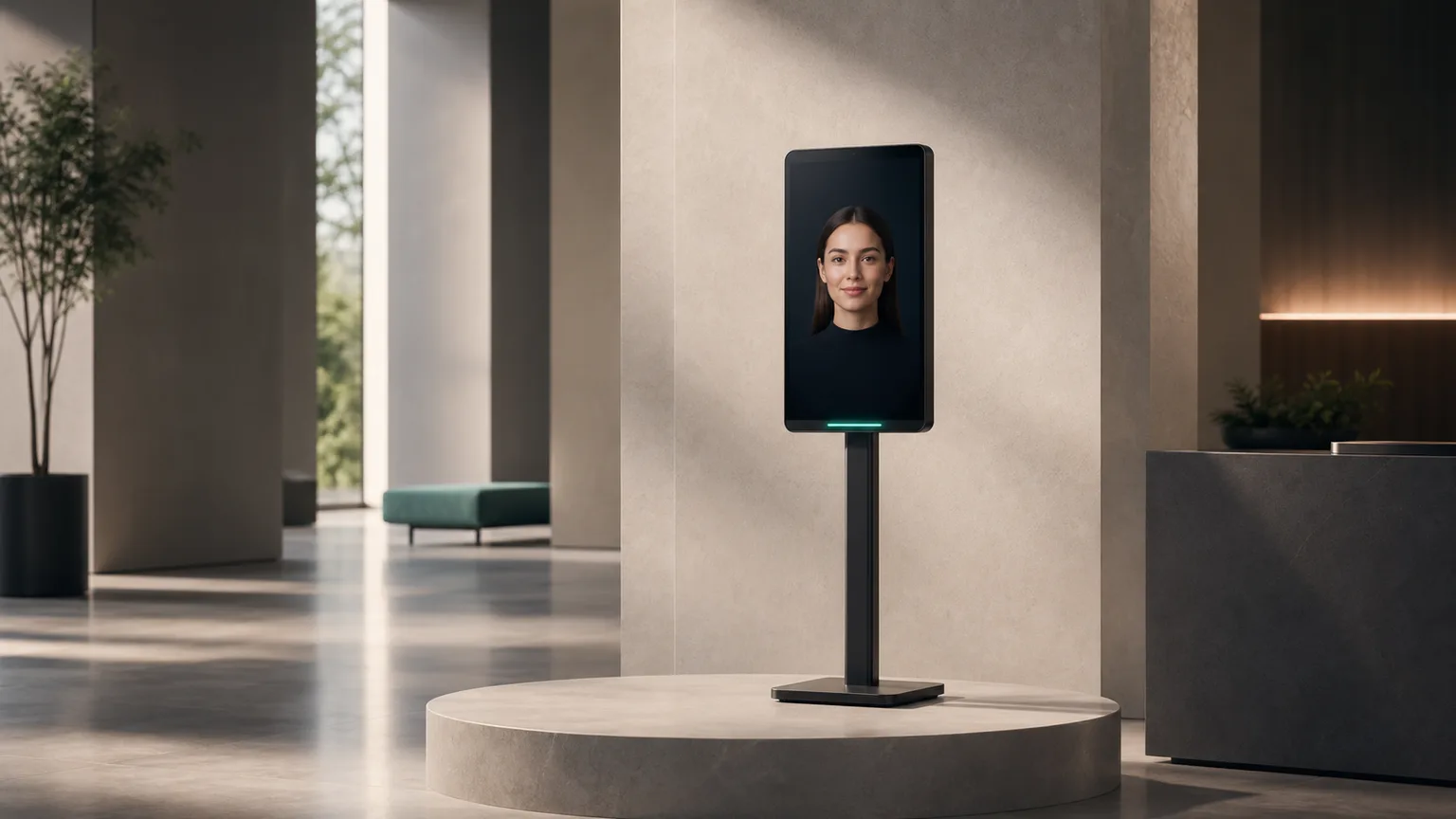
A physical kiosk in the lobby with a conversational AI avatar that greets visitors face-to-face, checks them in, verifies ID or insurance, answers open-ended questions, and writes the result back into your practice management or booking system in real time. This is the only category that replaces what a front-desk person does in person — greeting, verifying, and directing foot traffic — rather than what they do on the phone or online. Face2me falls into this category, alongside a handful of other kiosk vendors.
Best for: any business with meaningful walk-in or scheduled in-person traffic — clinics, dental offices, hotels, salons, gyms, auto shops — where the bottleneck is the lobby, not the phone line. See how this plays out by industry on our dental, hotel, and gym vertical pages, or browse the full list of 23+ verticals.
How to evaluate an AI receptionist
Whatever category you're shopping in, the same five criteria separate a tool that actually works from one that looks good in a demo and falls apart on day two.
- Languages. Does it auto-detect and respond in the languages your customers actually speak, or does it force a language-selection menu — or worse, only handle English? Multilingual auto-detection matters most for kiosks and phone agents serving walk-in or general-public traffic.
- Integrations. Can it write back in real time to the system you already run — Dentrix, Open Dental, Eaglesoft, AthenaHealth, Opera PMS, Mews, Mindbody, or your booking calendar — or does it just generate a lead someone has to re-key by hand?
- HIPAA compliance. If you're in healthcare, this isn't optional. You need a signed Business Associate Agreement (BAA) and a vendor that treats protected health information as a first-class requirement, not an add-on. See our HIPAA compliance breakdown for what that should actually include.
- Cost structure. Usage-based (per-minute, per-call) pricing is unpredictable and can spike in a busy month. Flat, tiered pricing is easier to budget against — but check what's actually included before comparing sticker prices across categories.
- Setup time. A chat widget can go live same-day. A kiosk needs hardware provisioning and a PMS integration, so realistic timelines run 1-2 weeks. If a vendor promises kiosk hardware live in 24 hours, ask hard questions about what "live" means.
Category comparison
| Criteria | Phone AI answering | Website chat agent | On-site AI kiosk |
|---|---|---|---|
| Handles walk-ins / lobby traffic | No | No | Yes |
| Handles phone calls | Yes | No | No (typically) |
| ID / insurance verification | No | No | Yes |
| Real-time PMS/CRM write-back | Sometimes | Sometimes | Usually, if built for it |
| HIPAA / BAA available | Varies by vendor | Varies by vendor | Varies by vendor |
| Languages | Varies, often English-first | Varies, often English-first | Often 30+ with auto-detect |
| Typical setup time | Same day to a few days | Same day | 1-2 weeks (hardware + integration) |
| Pricing model | Usually usage-based | Usually flat subscription | Usually flat, tiered |
Treat this table as a category-level shape, not a scorecard for any specific vendor — capabilities vary widely within each category, and the only way to know what a given tool actually does is to test it against your real workflow.
Where a kiosk receptionist fits
Phone AI and chat agents solve the "someone's trying to reach us and no one's answering" problem. A kiosk solves a different one: someone is already standing in your lobby, and there's no one there to greet them, verify who they are, or answer a question before they see a provider or check into a room. That's a distinct failure mode from a missed call, and it needs a distinct tool.
Face2me is built specifically for that in-person moment — an AI avatar kiosk that greets visitors, checks them in, verifies insurance or ID, answers open-ended questions in 30+ auto-detected languages, and writes results back into systems like Dentrix, Open Dental, Eaglesoft, AthenaHealth, Opera PMS, Mews, and Mindbody. It's not trying to replace your phone line or your website chat — it's covering the part of the front desk those two categories can't reach. Pricing runs on flat monthly tiers rather than per-call billing; see the full breakdown in how much an AI receptionist costs.
If lobby traffic, in-person verification, or multilingual walk-ins are where your front desk actually struggles, a kiosk is worth evaluating directly — you can book a live demo and check in a mock visitor yourself before deciding anything.
FAQ
What's the difference between an AI receptionist and an AI front desk?
In practice, the terms are used interchangeably, but "AI front desk" more often implies an in-person or lobby-facing tool — like a kiosk — while "AI receptionist" is used broadly across phone, chat, and kiosk categories. Always confirm which category a specific product falls into before comparing it to others; the label alone doesn't tell you what it does.
Can one AI receptionist handle phone, chat, and check-in?
Some vendors offer multiple channels under one platform, but most specialize — a kiosk vendor is usually strongest at in-person check-in and verification, not phone call handling, and vice versa. If you need all three covered well, it's often more reliable to pair a phone or chat tool with a dedicated kiosk than to rely on one generalist product for everything.
Do AI receptionists work for multilingual visitors?
It depends entirely on the vendor and category. Basic phone bots and chat widgets are frequently English-first with limited translation. Kiosk platforms built for walk-in traffic, including Face2me, tend to prioritize auto-detected multilingual support since a lobby can't rely on a guest selecting a language from a menu before they're understood.
Is a kiosk receptionist HIPAA compliant?
Only if the vendor explicitly supports it with a signed Business Associate Agreement — this isn't automatic in any of the three categories. For a clinic or dental office, confirm BAA coverage and how protected health information is handled before signing, not after. See our HIPAA guide for the full checklist.
How much does an AI receptionist cost?
It ranges from roughly $50/month for a basic phone AI answering service up to $1,500+/month for a turnkey AI kiosk with hardware, integrations, and support bundled in. The right comparison isn't cheapest-to-most-expensive — it's which category actually solves your front-desk bottleneck. Our full cost and ROI breakdown covers the numbers by category.