Hotel Self Check-In Kiosks: The 2026 Buyer's Guide
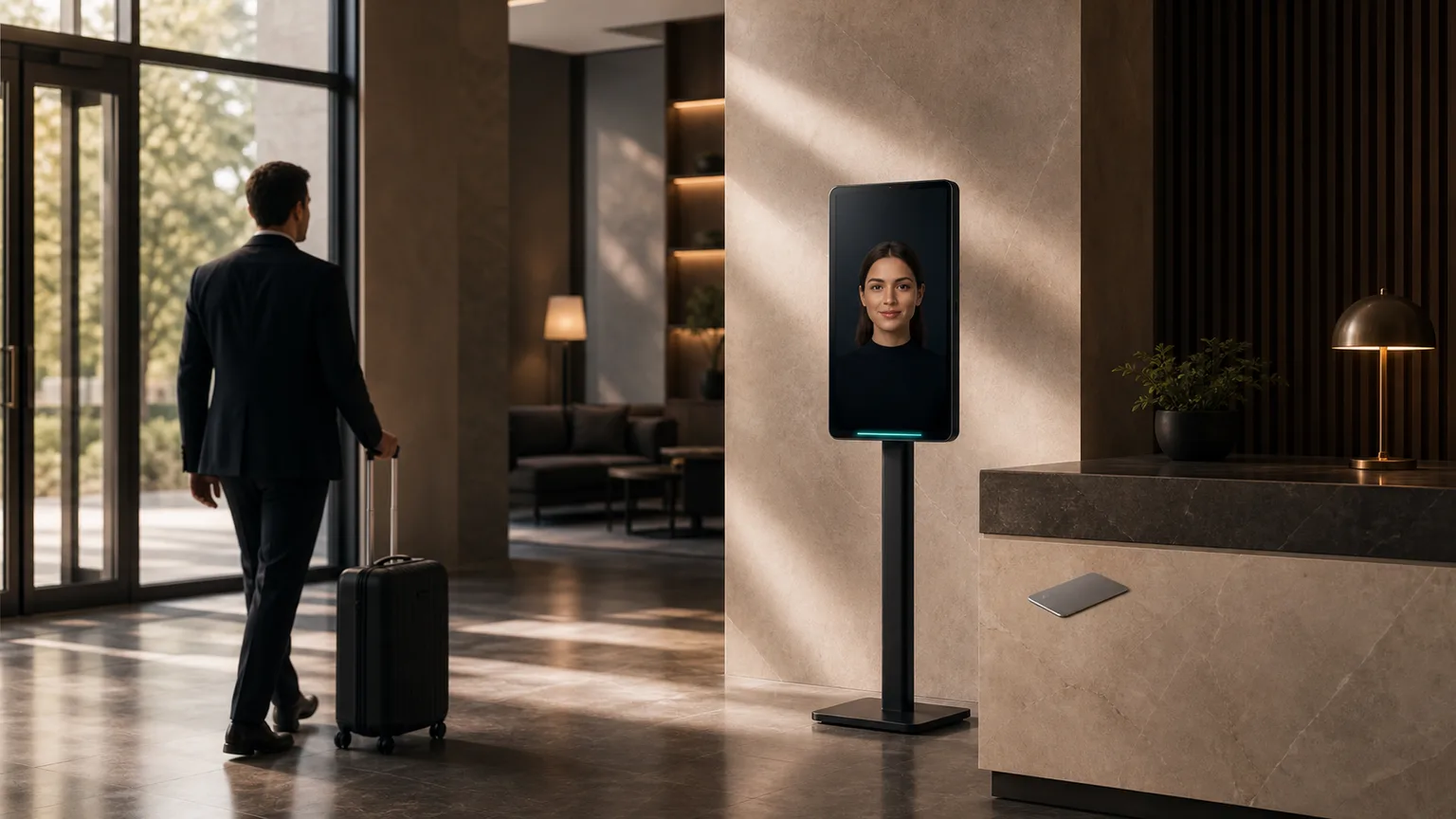
What is a hotel check-in kiosk?
A hotel check-in kiosk is a self-service terminal that lets arriving guests look up their reservation, verify identity, settle payment for incidentals, and receive a room key without waiting for a front desk agent. Modern kiosks sync in real time with the property's PMS — Opera PMS, Mews, or Cloudbeds — so room assignments and rate rules stay accurate.
That's the textbook definition. In practice, the kiosks worth buying in 2026 do a lot more than dispense a key card — and the gap between a basic touchscreen and an AI-driven front desk is now the whole buying decision.
Why hotels are adopting kiosks now
Three pressures are pushing hospitality operators toward self check-in at the same time.
Front-desk queues at peak
Bus tours, conference check-ins, and weekend arrivals all cluster into the same one-to-two-hour window. A single agent handling manual check-in averages 4-6 minutes per guest — passport scan, credit card hold, room assignment, key encoding. With 40 guests arriving between 3pm and 5pm, that math doesn't work. Guests stack up in the lobby, first impressions suffer, and TripAdvisor reviews mention "long wait at check-in" before they mention anything about the room.
A kiosk lets several guests check in simultaneously instead of queuing for one agent. That alone removes the bottleneck during the two hours a day it actually matters.
Night audit coverage
Staffing a front desk from 11pm to 7am costs a property $4,500+ per month in wages, and the person on that shift is idle roughly 70% of the time — most nights, nobody arrives between 2am and 6am. But when a late flight lands and a guest does show up at 1am, they need a working check-in process, not a dark lobby or a drowsy clerk who has to be woken from the back office.
A kiosk handles the 1am arrival exactly the same way it handles the 3pm rush: same speed, same accuracy, no shift differential. Many properties use this to eliminate a dedicated overnight position entirely, keeping a staff override available by phone for the rare exception.
Multilingual guests
International arrivals hit a language wall at exactly the worst moment — they're tired, disoriented, and trying to communicate check-in details through a stressed front-desk agent who doesn't speak their language. That friction shows up in review scores: language barriers can drag a property's TripAdvisor rating down by 0.3-0.5 stars. A kiosk that auto-detects the guest's language from their first words and conducts the entire check-in in it removes that friction before it ever becomes a review.
What the check-in flow actually looks like
A well-built kiosk flow runs through five steps, typically finishing in under two minutes:
- Reservation lookup — guest enters a confirmation number, scans a QR code from their booking email, or simply states their name.
- ID verification — passport or driver's license scan, matched against the reservation to confirm identity before a key is issued.
- Payment and incidentals — a card is authorized for the room hold and any add-ons; a connected payment terminal handles the transaction.
- Key dispensing or mobile key — the kiosk encodes a physical key card on the spot, or pushes a digital key straight to the guest's phone.
- PMS sync — the entire transaction writes back to Opera PMS, Mews, or Cloudbeds instantly, so housekeeping, the night audit, and the front desk all see the same record.
Done right, none of these steps require a human unless something falls outside the standard flow — a room change request, a billing dispute, a guest without a reservation. Those exceptions route to a staff override panel rather than stalling the queue.
AI-avatar kiosks vs. traditional touchscreen kiosks
This is the real fork in the market. Traditional kiosks are essentially ATMs for room keys: a menu tree, a card scanner, a receipt printer. They're reliable for the mechanical steps but silent on everything else — a guest with a question about parking, breakfast hours, or a late checkout has to find a human anyway.
AI-avatar kiosks like Face2me handle the same mechanical steps, but the interaction is a conversation instead of a menu. The guest can ask "is there a gym?" or "can I get a late checkout?" mid-check-in and get an answer immediately, in whatever language they're speaking. That conversational layer is also where upsell happens naturally — a room upgrade or spa package offered as part of the greeting converts at a rate that a static "Upgrade Now" button on a touchscreen never will.
The practical differentiators:
- Conversation vs. menu navigation — an avatar answers open-ended questions; a touchscreen only offers pre-scripted options.
- Upsell at the point of arrival — presented as a natural suggestion, not a checkout-page popup.
- 30+ languages, auto-detected — no language menu to click through; the avatar responds in whatever language the guest opens with.
- Consistent tone at any hour — a 3am check-in gets the same energy as a 3pm one.
Cost breakdown: hardware, SaaS, and turnkey service
Hotel kiosk pricing splits into three models, and they are not equivalent once you account for what's actually included.
Buy-your-own hardware. You purchase the kiosk enclosure, card reader, and printer outright — typically $3,000-$8,000 per unit — then separately license check-in software and pay for installation, PMS integration, and ongoing support yourself. Cheapest sticker price, highest total effort.
SaaS-only software. A vendor licenses you check-in software that you run on hardware you source and maintain. Lower upfront cost than buying a full turnkey unit, but you own the integration work and the support burden when something breaks at 2am.
Turnkey service. Everything — hardware, software, PMS integration, ongoing support, and updates — bundled into one monthly fee. Face2me's hotel plans start from $599/month for a single property with setup from $2,000, scaling to $999/month for up to three properties (setup from $8,000) and $1,500+/month per property at enterprise scale. Hardware installs on-site and comes back to us if you ever cancel — no annual contract, no exit fee.
For a single boutique property, the turnkey model usually wins on total cost once you price in the engineering hours a SaaS-only setup demands for PMS integration and maintenance. For a multi-property group with in-house IT, buy-your-own can make sense — but budget for the integration work up front, not as an afterthought.
Implementation checklist
Before signing anything, confirm:
- PMS compatibility — does the vendor have an existing integration with your system (Opera PMS, Mews, Cloudbeds), or will this require custom API work?
- Payment terminal support — can it process incidentals and upsells through your existing merchant processor?
- ID verification method — passport/ID scan accuracy, and what happens on a failed match.
- Language coverage — how many languages, and is detection automatic or menu-driven?
- Staff override path — how does an agent step in for an exception without restarting the guest's session?
- Go-live timeline — a realistic install takes 7-10 business days from signup, including an on-site visit to connect the kiosk to your PMS and configure workflows around your room inventory.
- Contract terms — month-to-month vs. annual lock-in, and what happens to the hardware if you cancel.
If you want to see the flow end to end before committing to any of this, book a demo and walk through a live check-in on the actual kiosk software.
FAQ
Does a hotel self check-in kiosk replace the front desk entirely? Not usually, and it doesn't need to. Most properties keep a staff override available for exceptions — billing disputes, walk-ins without a reservation, special requests — while the kiosk handles the standard check-in flow. What it does eliminate is the need to staff a dedicated overnight shift or a second agent during peak arrival hours, since the kiosk handles simultaneous check-ins without a queue.
How does a hotel check-in kiosk integrate with my property management system? A kiosk built for hospitality syncs directly with your PMS — Opera PMS, Mews, or Cloudbeds are the most common integrations — so reservation lookup, room assignment, and rate rules pull live data instead of requiring manual entry. Face2me's setup process connects to your PMS during installation, typically completing go-live within 7-10 business days. If your property runs a different system, a custom integration is built during onboarding.
Are AI kiosks with avatars worth the extra cost over a basic touchscreen kiosk? It depends on what you're optimizing for. A basic touchscreen is cheaper and handles the mechanical steps of check-in fine. An AI-avatar kiosk costs more but answers open-ended guest questions in 30+ languages, presents upsells conversationally instead of as a static button, and gives a consistent guest experience at any hour — advantages that matter most for properties with international guests, high peak-hour volume, or an ambition to reduce night-shift staffing. For a small property with a mostly domestic, low-volume guest base, a simpler kiosk may cover the need.
Ready to see it on your own reservations? Explore the hotel kiosk in detail or book a live demo to walk through a check-in start to finish.