Virtual Receptionist for Chiropractors: 2026 Guide
What's the best virtual receptionist for chiropractors?
Chiropractic front desks have a problem most other clinics don't: an enormous share of daily traffic is patients you've already seen, coming back for the third or twentieth time in a treatment plan. That repeat-visit volume changes what "virtual receptionist" should even mean for a chiro practice. A generic AI phone agent built for one-off appointments doesn't help much if your real bottleneck is checking in 30 returning patients between 8am and noon without a line forming at the counter.
There are three real options — a remote answering service, an AI phone agent, and an in-office kiosk — and they solve different pieces of the problem. Most chiropractic offices actually need two of the three working together, not one tool trying to do everything.
The front-desk pain specific to chiropractic practices
A few things make chiro different from a typical medical office:
- High-frequency repeat visits. Active treatment plans often mean 2-3 visits per week for the same patient over several weeks. That's a front desk doing the same check-in, insurance-status confirmation, and co-pay collection dozens of times a day for people who already exist in the system.
- Walk-ins alongside scheduled visits. Many chiro patients book their next adjustment on the way out, and same-day walk-ins are common for acute pain. A phone-only system does nothing for someone who's already standing in the lobby.
- Insurance verification friction. Chiropractic coverage varies wildly by plan — visit caps, medical necessity requirements, co-pay tiers — and confirming status for a returning patient at every visit eats staff time that a one-time verification wouldn't.
- Small staff, high volume. Solo and small-group chiropractic practices frequently run with one front-desk person covering phones, check-in, and billing questions simultaneously. Any one of those pulling their attention away slows down the whole waiting room.
Option 1: Remote answering service
A live or semi-live human answering service, usually shared across many client businesses, that picks up calls, books appointments, and takes messages. Pricing typically runs $300-$1,000+/month and scales with call volume, since you're paying for human labor on the back end.
This solves missed calls and after-hours coverage. It does nothing for the patient standing in your waiting room — someone still has to physically check them in, confirm insurance, and get them into a treatment room.
Option 2: AI phone agent
Software that answers inbound calls, books and reschedules appointments, and handles basic FAQs without a human on the line. Pricing runs $50-$300/month, usually with a usage tier. This is a meaningful upgrade over voicemail for a solo practitioner whose main problem is picking up the phone between adjustments, but it's still phone-only — it can't verify a patient's insurance status at the counter or move a full waiting room through check-in.
Option 3: In-office AI kiosk
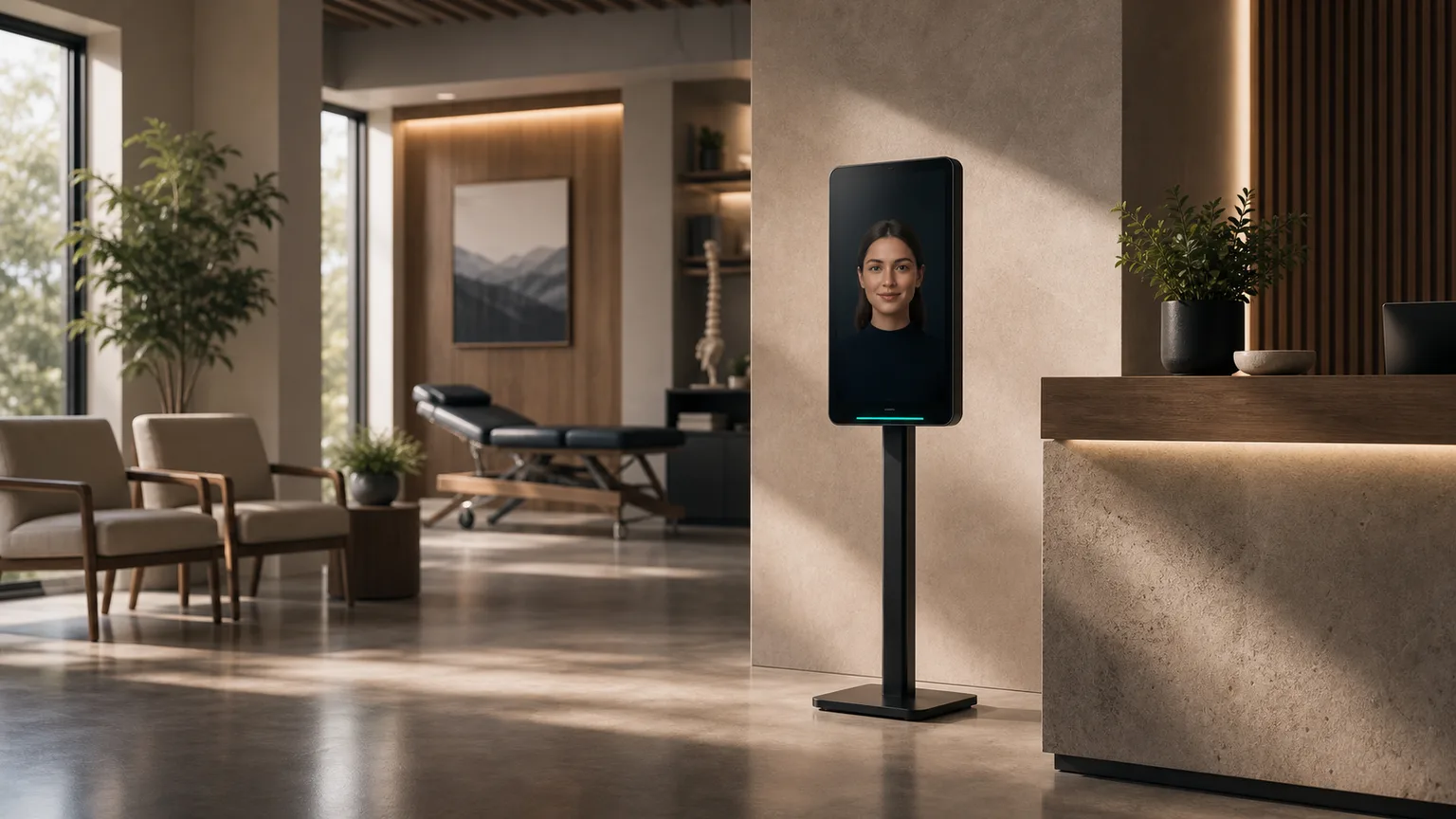
A touchscreen kiosk in the lobby with a conversational AI avatar that greets patients by name, checks them in, confirms insurance and co-pay status, and writes the result back into your practice management system in real time — no phone number needed, no human required to staff it. Face2me falls into this category. Pricing is flat and tiered rather than usage-based: Starter from $599/month, Growth from $999/month, both including hardware, software, integrations, and support.
This is the only option built for chiropractic's actual traffic pattern — a lobby full of returning patients who need to be recognized and moved through fast, not a phone that needs answering.
What a returning-patient check-in actually looks like
For a chiro practice specifically, the kiosk workflow matters more than the marketing copy, so here's what it looks like in practice:
- A returning patient walks in for their third visit this week. They approach the kiosk instead of waiting for the front-desk person to finish a phone call.
- The avatar greets them by name and pulls their existing record — no re-entering personal information they already gave you at intake.
- It confirms insurance and visit status against what's on file, flagging anything that's changed (a new visit cap reached, a plan update) before they see the chiropractor, not after.
- Check-in completes in under 60 seconds, and the patient is marked ready in the system your staff already uses.
- Front-desk staff stays free to handle the phone, a billing question, or a new-patient intake — instead of running the same three-minute check-in script for the tenth time that morning.
Face2me's name-match accuracy for returning patients runs at 99.2%, so patients aren't stuck correcting a misidentified record at the counter, and practices using kiosk check-in and reminders together see roughly 40% fewer no-shows — meaningful in a treatment-plan model where a missed visit sets back the whole schedule.
The HIPAA question
Chiropractic offices handle protected health information — treatment notes, insurance details, injury history — the same as any other medical practice, so HIPAA compliance isn't optional for a kiosk that's touching that data. Any vendor you evaluate should offer a signed Business Associate Agreement (BAA), not just a claim of "HIPAA-friendly" on a marketing page. Face2me includes HIPAA compliance and a signed BAA on every tier; see the full HIPAA compliance breakdown for what that should cover before you sign with any vendor.
Cost comparison at a glance
| Option | Monthly cost | Handles walk-ins | Insurance/ID verification |
|---|---|---|---|
| Remote answering service | $300-$1,000+ | No | No |
| AI phone agent | $50-$300 | No | No |
| In-office AI kiosk (Face2me) | $599-$999+ | Yes | Yes |
For most chiropractic practices, the phone side and the lobby side are genuinely separate problems — a phone agent or answering service to stop missing calls, and a kiosk to move returning patients through check-in without a line at the counter. See the full breakdown of how these categories compare across industries in best AI receptionist options, or the complete cost math in how much an AI receptionist costs.
Where Face2me fits for chiropractic
Face2me is built for exactly the traffic pattern chiropractic offices deal with every day — high-frequency returning patients, walk-ins alongside scheduled visits, and a small staff that can't afford to run the same check-in script dozens of times a shift. It checks patients in under 60 seconds, verifies insurance automatically, and works in 30+ auto-detected languages for practices serving multilingual patient bases. See how it's configured specifically for chiro offices on our chiropractic vertical page, or book a live demo and check in a mock patient yourself.
FAQ
Is a virtual receptionist worth it for a small chiropractic office?
It depends on where the bottleneck actually is. If missed calls are the main issue for a solo practitioner, an AI phone agent at $50-$300/month solves that cheaply. If the real problem is a waiting room full of returning patients and a front desk that can't keep up, a kiosk solves a different, often more costly problem — and it typically pays for itself against the cost of the front-desk hours it frees up.
Can an AI kiosk verify chiropractic insurance at check-in?
Yes. Face2me confirms insurance and visit status against your practice management system at check-in, flagging changes — like a visit cap reached or updated plan details — before the patient sees the chiropractor rather than after, when it's harder to resolve.
Do chiropractic patients need to create an account to use the kiosk?
No. Returning patients are recognized and matched to their existing record automatically, with 99.2% name-match accuracy, so there's no separate login or account creation step slowing down a visit that should take under a minute.
How does a kiosk reduce no-shows for chiropractic practices?
Kiosk check-in paired with automated reminders keeps a treatment plan's cadence more consistent — patients who check in fast and get automatic reminders for their next visit are less likely to drop off mid-plan. Practices using this combination see roughly 40% fewer no-shows compared to phone-and-paper scheduling alone.
Is a chiropractic virtual receptionist HIPAA compliant?
It should be, but confirm before signing. Face2me includes HIPAA compliance and a signed Business Associate Agreement on every tier, since chiropractic check-in involves protected health information like treatment notes and insurance details. See our HIPAA compliance breakdown for what to check with any vendor.