AI Receptionist for Optometry Practices: 2026 Guide
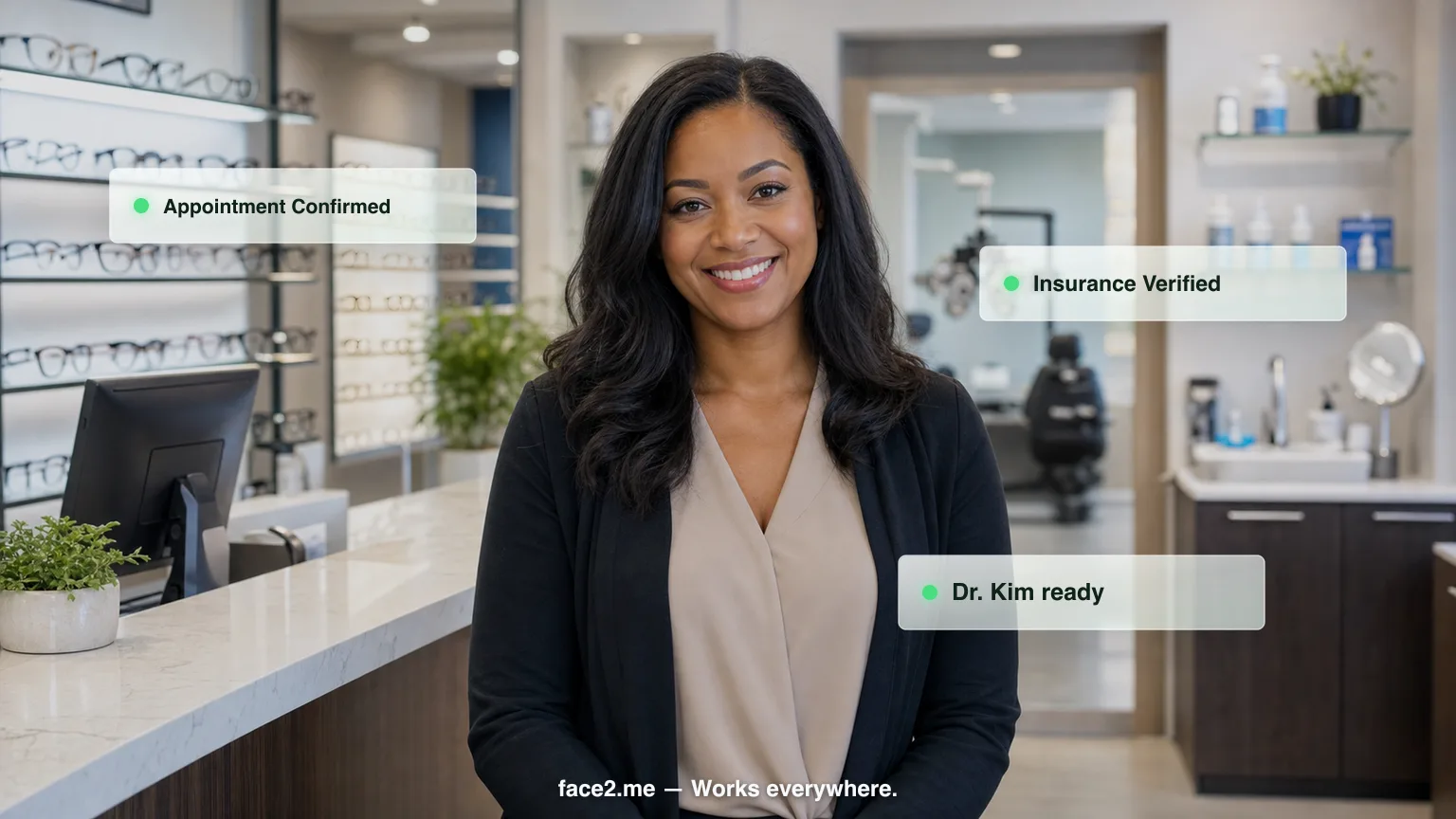
What does an AI receptionist do for an optometry practice?
An AI receptionist for optometry practices checks patients in, verifies vision insurance eligibility in seconds instead of minutes, runs the pre-visit questionnaire, and books frame try-on appointments — all before the patient sits down in the exam chair. The bigger problem it solves isn't just check-in speed: it's that most optometry practices have their opticians splitting time between the front desk and the optical floor, and every minute spent verifying a vision plan by phone is a minute not spent selling frames.
That's a different calculation than a typical medical front desk. A dental or urgent care practice loses time to insurance calls too, but an optometry practice loses revenue directly — a distracted optician who can't get to the display wall is a $500 frame sale that walks out the door instead of closing. The three real options for handling this — a phone answering service, an AI phone agent, and an in-office kiosk — solve different parts of that problem, and most practices actually need to think about which one fixes the part that's costing them money.
Why optometry check-in is different from a typical medical front desk
A handful of things separate optometry from a general medical office:
- Vision insurance verification is uniquely slow. Vision plans (VSP, EyeMed, Davis Vision, and medical-side coverage for eye exams) often require separate verification calls from a patient's general medical insurance, and that process commonly takes 8–12 minutes per patient — the single biggest bottleneck at check-in.
- The front desk and the sales floor compete for the same staff. Opticians are trained to sell frames and contacts, not verify insurance. Every minute an optician spends on check-in duties is a minute they're not on the optical floor helping a patient choose frames.
- Frame try-on scheduling is usually phone-only. Without an easy way to book a dedicated try-on slot, walk-in frame browsing gets deprioritized behind exam scheduling, and appointment volume on the optical side stays lower than it could be.
- Contact lens reorders lapse quietly. Without a consistent reminder system, patients let prescriptions expire or start buying lenses from an online retailer instead of reordering through the practice — a recurring revenue stream that just leaks away.
The three ways to handle optometry front-desk work
1. Phone answering service: $300–$1,000+/month
A live or semi-live human service — usually shared across many client businesses — that answers calls and books or reschedules exams. Pricing scales with call volume since you're paying for human labor on the back end. It solves missed calls, but it does nothing for the patient standing at your counter or the optician who's stuck verifying a vision plan instead of showing frames.
2. AI phone agent: $50–$300/month
Software that answers inbound calls and handles basic scheduling or FAQs without a human on the line. A real upgrade over voicemail for a solo practice missing calls during exams, but it's phone-only — it can't verify vision insurance in real time or check a patient in when they walk through the door.
3. In-office AI kiosk: $599–$1,500+/month
A touchscreen kiosk in the lobby with a conversational AI avatar that greets patients, checks them in, verifies vision insurance eligibility automatically, and writes results back into your practice management system in real time. Face2me falls into this category. Pricing is flat and tiered — Starter from $599/month, Growth from $999/month, Enterprise from $1,500/month per location — with hardware, software, integrations, and support included in every tier.
This is the only option built for the specific math behind an optometry front desk: verification speed matters because it determines how fast your opticians get back to selling.
What optometry kiosk check-in actually looks like
- A patient walks in for a scheduled exam, a contact lens fitting, or a frame try-on appointment.
- The kiosk avatar greets them and pulls their record, confirming contact details and prescription history on file so nothing needs to be re-entered from scratch.
- It runs automatic vision insurance eligibility verification — Face2me completes this roughly 10x faster than a manual phone call to the payer, turning an 8–12 minute bottleneck into a near-instant check.
- A short pre-visit questionnaire captures symptoms, prescription changes, and contact lens preferences before the doctor walks in.
- Check-in completes in under 60 seconds, and the visit is marked ready directly in the practice management system your staff already uses.
- The kiosk offers frame try-on scheduling as part of check-in or checkout, so booking a dedicated try-on slot doesn't depend on someone calling the front desk later.
Face2me's name-match accuracy for returning patients runs at 99.2%, which matters in a practice where the same patient may come back yearly for an exam and separately for contact lens reorders — a misidentified record means a lost prescription history at exactly the wrong moment.
Does an optometry kiosk protect frame and contact lens revenue?
Indirectly, and meaningfully. Face2me doesn't sell frames or contacts itself, but it removes the front-desk drag that keeps opticians away from the optical floor. Practices using kiosk check-in report booking around 30% more frame try-on appointments, simply because scheduling one no longer depends on catching the front desk between phone calls. Automated SMS reminders for contact lens reorders also help patients reorder through the practice instead of letting a prescription lapse or buying from an online retailer by default — and the same reminder system cuts appointment no-shows by roughly 40%, protecting the exam volume that drives frame and lens sales in the first place.
Is an AI receptionist for optometry practices HIPAA compliant?
Yes — vision exams, prescriptions, and insurance verification all involve protected health information, so a compliant kiosk isn't optional. Face2me is HIPAA compliant and includes a signed Business Associate Agreement at no extra cost. Every check-in, insurance verification, and payment action on the kiosk is logged, the platform runs on 99.9% uptime infrastructure, and patient data is stored for 180 days before automatic deletion. See the full breakdown on our HIPAA compliance page.
Cost comparison at a glance
| Option | Monthly cost | Verifies vision insurance | Books frame try-ons |
|---|---|---|---|
| Phone answering service | $300–$1,000+ | No | No |
| AI phone agent | $50–$300 | No | No |
| In-office AI kiosk (Face2me) | $599–$1,500+ | Yes, automatic | Yes |
For most optometry practices, the phone and lobby problems are genuinely separate — an answering service or phone agent to stop missing calls between exams, and a kiosk to speed up the verification and check-in work that's currently pulling opticians off the sales floor. See the full cost math across categories in how much an AI receptionist costs, or how the categories stack up generally in best AI receptionist options. Dental practices face a similar insurance-verification bottleneck — see how one practice tackled it in how dental clinics save $3,500/month.
Where Face2me fits for optometry practices
Face2me is built for the specific economics of an optometry front desk: verification speed isn't just a convenience, it's what determines whether your opticians are selling frames or stuck on hold with a vision plan. It checks patients in under 60 seconds, verifies vision insurance roughly 10x faster than a manual call, books frame try-on appointments without a phone tag, and works in 30+ auto-detected languages for practices serving multilingual patients. See how it's configured specifically for optometry on our optometry vertical page, or book a live demo and run a mock vision insurance check yourself.
FAQ
How much does an AI receptionist cost for an optometry practice?
Face2me starts at $599/month for a single-location practice (Starter plan), with setup from $2,000. Multi-location groups use Growth at $999/month for up to 3 locations (setup from $8,000), or Enterprise at $1,500+/month per location for larger groups with custom setup. Pricing is month-to-month with no annual contract, and hardware, software, and support are all included.
Can a kiosk actually verify vision insurance before the exam?
Yes. Face2me runs automatic vision insurance eligibility verification at check-in, completing it roughly 10x faster than a manual phone call to the payer. It also collects the pre-visit questionnaire — prescription history, symptoms, and contact lens preferences — in the same session, so front desk staff aren't tied up on hold with insurers.
Does Face2me integrate with Eyefinity, OfficeMate, RevolutionEHR, or Crystal PM?
Face2me isn't a replacement for your practice management software — it's a kiosk that connects to the system you already run. Confirmed integrations include AthenaHealth and Stripe payment terminals, alongside PM and scheduling platforms across dental, medical, and hospitality settings. For optometry-specific systems like Eyefinity, OfficeMate, RevolutionEHR, or Crystal PM, the Face2me team builds a custom API integration during setup, so your staff won't need to configure it themselves.
Will an AI receptionist actually help sell more frames?
Face2me doesn't sell frames or contacts directly, but it removes the front-desk drag that keeps opticians off the sales floor. Practices using kiosk check-in report booking about 30% more frame try-on appointments, since scheduling one no longer depends on catching the front desk between calls, and SMS reminders that cut no-shows by roughly 40% help protect the exam volume that drives optical sales.
How long does it take to install a check-in kiosk in an optometry office?
Go-live takes 7–10 business days from a signed agreement. The Face2me team visits your practice on-site to install the kiosk, connect it to your practice management system — including a custom API integration if you use a platform like Eyefinity or OfficeMate — and configure vision insurance verification workflows before your front desk starts using it.