AI Receptionist for Local Businesses (2026 Guide)
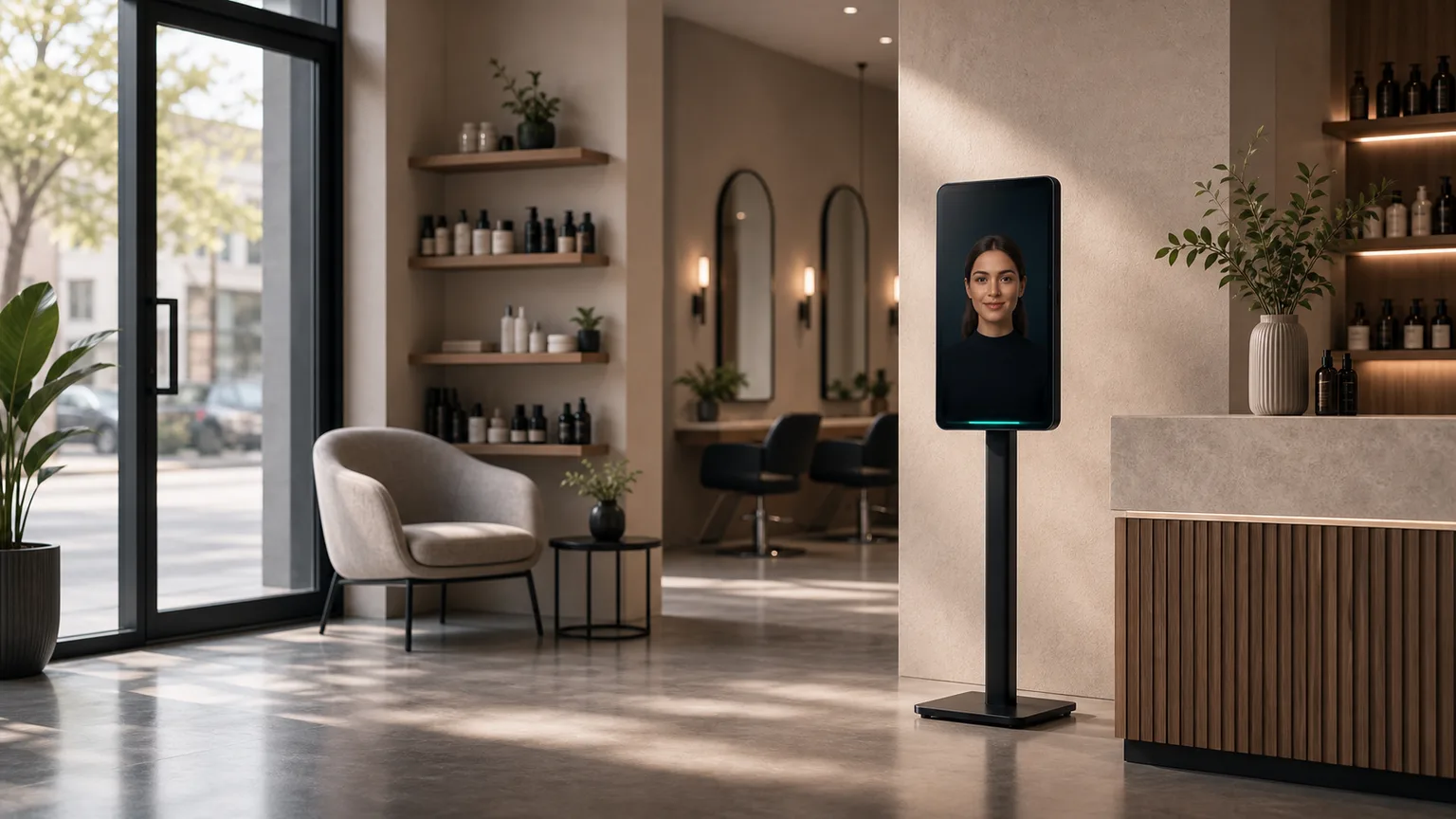
Do local businesses actually need an AI receptionist?
Most of the AI receptionist coverage online is written for healthcare and hospitality — dental offices, hotels, hospitals. But the same front-desk problems show up everywhere a customer walks through a door and needs to be checked in, looked up, or pointed somewhere: a yoga studio with a 6am class starting in four minutes, a pet supply store with one employee stocking shelves and a line at the register, a boxing gym where the front desk doubles as the person running the noon class.
An AI receptionist kiosk works for these businesses the same way it works for a clinic — it greets whoever walks in, looks them up, checks them in, answers routine questions, and hands off anything it can't resolve. It doesn't replace the owner or the trainer. It replaces the standing requirement that someone always be at the door.
Below is how it plays out for five specific business types, each shaped around what actually happens at their front desk.
AI Receptionist for Yoga Studios
A yoga studio's front-desk problem is timing, not volume. Classes run back-to-back, the instructor teaching the 6am class is also the person who'd normally check people in, and a five-minute gap between classes isn't enough time to greet drop-ins, look up memberships, and start on time.
A kiosk handles the parts that don't need a teacher:
- Class check-in. A member scans a QR code or types their name; the kiosk confirms their spot against that day's class roster and logs attendance automatically — no clipboard, no sign-in sheet at the door.
- Membership and package lookup. New or infrequent visitors get an instant read on remaining class credits, membership status, or whether a package has expired, without a staff member stopping mid-setup to check a system.
- Walk-in and drop-in questions. "Is there a class starting soon?" "Do you rent mats?" "What's the cancellation policy?" — the avatar answers these directly in the language the visitor speaks, freeing the instructor to focus on the mat, not the door.
- New student intake. Waiver signing and first-visit paperwork happen at the kiosk before class starts, instead of eating into class time or requiring a separate front-desk hire just to manage intake.
See how this maps onto a broader wellness setup in our fitness vertical breakdown.
AI Receptionist for Boxing Clubs
Boxing clubs and combat-sports gyms have a version of the same problem, amplified: classes are loud, the front desk is often unstaffed during open gym hours, and members expect to walk in, tap a card, and get on the bag — not wait for someone to look up their account.
- Membership check-in with account status. The kiosk confirms an active membership or class package before letting someone onto the floor, catching lapsed accounts without an awkward confrontation at the ring.
- Walk-in trial and drop-in booking. Prospective members can book a trial class or single session directly at the kiosk, capture contact info, and get routed to a coach — without a staff member interrupting a class to run the conversation.
- Retail and gear questions. Wraps, gloves, and apparel sales are common at boxing gyms; the kiosk fields "do you sell 16oz gloves" or "what sizes do you carry" without pulling a trainer off the floor.
- Class schedule and waitlist. Popular classes fill up fast — the kiosk shows real-time availability and adds walk-ins to a waitlist automatically.
AI Receptionist for Tutoring Centers
Tutoring centers run on tight scheduling blocks, parent hand-offs, and a front desk that's frequently one person managing multiple simultaneous sessions in different rooms.
- Student sign-in and sign-out. Parents and students check in for their scheduled session, and the kiosk logs the exact time in and out — useful for both attendance tracking and billing by session hours.
- Appointment and session booking. New families or existing ones needing to reschedule can book directly at the kiosk instead of waiting on hold or emailing, and the booking syncs to the center's calendar in real time.
- Parent pickup coordination. The kiosk can notify staff when a parent has arrived for pickup, reducing the awkward stretch where a student waits at the front unsupervised.
- General inquiries. "Do you tutor SAT math?" "What are your rates for a 10-session package?" — walk-in questions get answered immediately instead of requiring a callback later.
AI Receptionist for Pet Supply Stores
Pet supply and specialty pet stores are retail-first but have real check-in needs too — grooming appointments, curbside pickup, loyalty programs — layered on top of a small staff that's usually restocking or ringing up a register.
- Grooming and service check-in. Customers dropping off a pet for grooming or a nail trim check in at the kiosk, which confirms the appointment and notifies the groomer, instead of waiting at a counter for someone to notice them.
- Curbside and online order pickup. The kiosk confirms an order number and flags staff to bring it out, cutting the "I'm here for my pickup" interruption during a busy shift.
- Walk-in product and stock questions. "Do you carry grain-free food for large breeds?" "Where's the fish section?" — routine questions get handled at the door so the one employee on the floor isn't pulled off a task every few minutes.
- Loyalty program lookup. Members can check point balances or redeem a reward directly at the kiosk without a staff member manually pulling up an account.
Pet businesses with a veterinary or wellness component can see the clinical side of this in our veterinary vertical breakdown.
AI Receptionist for Real Estate
Real estate offices have a different failure mode: the front desk is empty for long stretches because every agent is out showing property, and a walk-in prospect who doesn't get greeted within a minute or two often just leaves and calls a competitor.
- Visitor greeting and agent routing. A walk-in states what they're looking for — buying, selling, renting — and the kiosk routes them to the right available agent or captures their info for a callback, rather than leaving them standing in an empty lobby.
- Appointment and showing check-in. Buyers arriving for a scheduled showing or listing appointment check in automatically, and the assigned agent gets notified immediately.
- Lead capture after hours. Offices with foot traffic outside normal hours — open house follow-ups, evening walk-ins — capture contact details and interest even when no agent is on-site.
- Property and listing questions. Basic questions about current listings, price ranges, or neighborhoods get answered on the spot instead of requiring a wait for an agent to return.
Details on how this fits a brokerage or office setup are in our real estate vertical breakdown.
How to choose the right AI receptionist for a local business
Across all five of these — and the other 18+ industries Face2me serves — the decision usually comes down to the same four questions:
- Does it need to handle a physical walk-in, not just a phone call? If your business has foot traffic that needs greeting, checking in, or routing, a phone-only AI answering service won't cover the gap. You need something at the door.
- Does it need to look up an account, membership, or appointment in real time? Generic chatbots can answer FAQs, but checking a membership status or confirming a scheduled session against a live system requires an actual integration, not a script.
- Do your customers speak more than one language? Auto-detected multilingual support matters more than most owners expect once you look at actual walk-in traffic — Face2me supports 30+ languages without a setup step per language.
- What's the real cost of an empty front desk? A missed walk-in at a real estate office or a late check-in at a boxing gym has a cost, even if it's not itemized anywhere. Weigh a $599-$999/month kiosk against the labor cost of staffing a desk for coverage you don't consistently need.
Face2me runs check-ins in under 60 seconds with a 99.2% name-match rate, and businesses using it for appointment-based traffic have seen roughly 40% fewer no-shows from automated reminders — numbers that hold whether the front desk in question is a dental clinic or a yoga studio. The best way to see how it fits your specific layout and hours is to book a live demo and walk through your actual walk-in flow with us.
FAQ
Can an AI receptionist work for a small local business, not just healthcare or hotels?
Yes. The underlying problem — someone needs to be at the door to greet, check in, and answer routine questions — is the same whether it's a dental office or a yoga studio. Face2me serves 23+ industries, including fitness studios, tutoring centers, retail, and real estate, with the same core kiosk checking members in, looking up appointments, and routing questions.
Does it replace my front-desk staff entirely?
No, and it isn't meant to. It handles the repetitive, high-volume parts of a front desk — check-in, lookup, routing, basic Q&A — so existing staff spend their time on the parts that need a person: teaching a class, running a session, closing a sale. Most businesses use it to cover gaps rather than eliminate a role outright.
Can it handle walk-ins who aren't in the system yet?
Yes. For a trial class, a first-time tutoring inquiry, or a new real estate prospect, the kiosk captures name and contact info and either books an appointment directly or routes the lead to staff for follow-up, so a walk-in never has to leave without being logged.
How long does setup take for a small business location?
Most locations are live in 7-10 business days from signing, including hardware provisioning and configuration of your specific check-in or booking workflow. There's no lengthy custom build required for standard use cases like class check-in or appointment lookup.
What does it cost for a single-location business?
Face2me's Starter tier starts at $599/month with setup from $2,000, covering one location with hardware, software, and support included. Growth is $999/month for up to three locations. Both are month-to-month with no exit fees, so a single studio or store isn't locked into a long-term contract to try it.